Introduction
The city of Ephesus, located at the mouth of the Cayster River, was the capital of the Roman
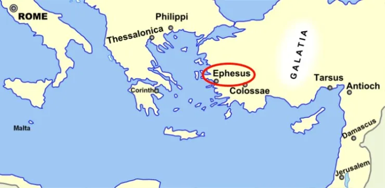
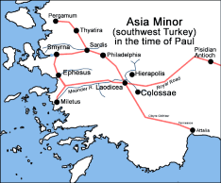
province of Asia Minor.
Because of its fine harbour, people traveled from the Egyptian port at Alexandria, across the Mediterranean Sea to the port at Ephesus from where they could venture through to Asia Minor on quality Roman roads. Many of which led from Ephesus. The city of 300,000 people became the most important commercial center of Roman Asia. See images. Of his three plus missionary journeys, it is no wonder that Paul spent more than three years in this strategic place.
Archaeology
As shown above, Ephesus was a major trading destination which was the life blood of the city, but as the river deposited silt in the harbor its mouth kept moving further away from the city, and without a trade Ephesus started to decline. In 614, it was partially destroyed by an earthquake, and this dealt a final blow to the once thriving capital. Over time, the ruins of Ephesus were buried – waiting for archaeologists to unearth them. In the early 1860s, the British Museum financed archaeological work at Ephesus. Excavations stopped in 1874, but began again in 1895 with German archaeologist Otto Benndorf, financed by Austrian Karl Mautner Ritter von Markhof. In 1898, Benndorf founded the Austrian Archaeological Institute, which plays a leading role in excavating Ephesus today. At present, about 25% of the city has been unearthed.
Ephesus in Paul’s time
The major places and buildings mentioned in the New Testament have been either discovered or confirmed in another way. Below, is the biblical citation of an Ephesian place/building followed by its discovery.
Acts 19:1, And it happened that while Apollos was at Corinth, Paul passed through the inland country and Ephesus.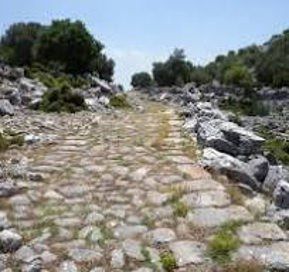
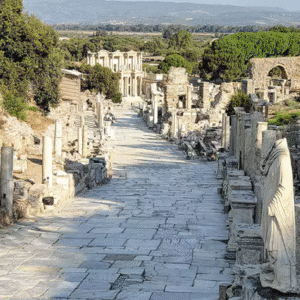
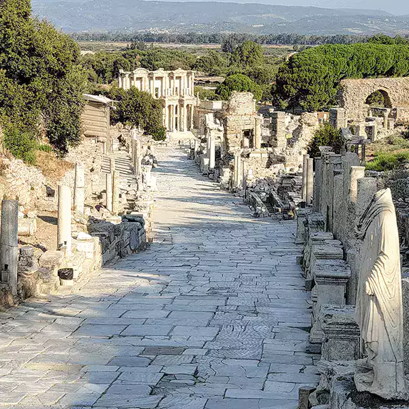
Paul was blessed with many quality roads which the Romans had constructed so they could move their military from one theater of operation to another. He made good use of them on his many missionary journeys. Ephesus, being a provincial Roman capital, was well serviced with these roads and the one he most likely used was the Via Sabaste. A picture of it is attached compliments of Wikimedia commons.
Acts 19:8-9, Paul entered the synagogue and spoke boldly there for three months, arguing persuasively about the kingdom of God. But some of them became obstinate; they refused to believe and publicly maligned the Way. So Paul left them. He took the disciples with him and had discussions daily in the lecture hall of Tyrannus.
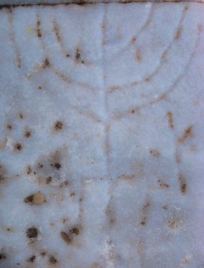 Only 20-25% of Ephesus had been excavated. Many of the most significant buildings have been unearthed, but unfortunately the synagogue has not been discovered yet. However, Jewish historian Josephus discussed the Jewish people in Ephesus in several of his documents with dates ranging from 49 BC to AD 3[1]
Further evidence of a Jewish presence in Ephesus are three menorah graffiti. One on the marble steps of the Celsus library which is shown.[2]
The Hall of Tyrannus
This may not be a particular building but rather a place that Tyrannus had rented. However, there is inscriptional evidence that Tyrannus was a name, common in Ephesus. Several have been found in the city dating from approximately AD 54-93, including one on a stone pillar.[3]
Acts 19:19, A number who had practiced sorcery brought their scrolls together and burned them publicly. When they calculated the value of the scrolls, the total came to fifty thousand drachmas.
Sorcery
Sorcery flourished in the first century, and not just in Ephesus. Excavations have uncovered many “curse tablets” (katadesmos), which are small, thin lead plates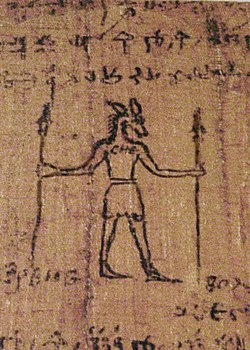 containing inscriptions meant to influence behaviors or curse others. Around 50 of these have been found in Ephesus, specifically around the expensive Terrace Houses, often hidden near drains or graves to reach underworld spirits.
The Greek Magical Papyri (PGM): These are actual collections of magical spells and rituals dating from the 1st to 5th centuries AD, which align with the types of spells used in Ephesus. They contain instructions for invoking spirits, binding lovers, and gaining power, like the “books” described in Acts. An example from the PGM is shown.[4]
A lot of money went up in smoke when the people burnt their scrolls worth 50,000 drachmas as one drachma is the value of one day’s wage.
Acts 19:26-27. And you see and hear how this fellow Paul has convinced and led astray large numbers of people here in Ephesus and in practically the whole province of Asia. He says that gods made by human hands are no gods at all. There is danger not only that our trade will lose its good name, but also that the temple of the great goddess Artemis[5] will be discredited; and the goddess herself, who is worshiped throughout the province of Asia and the world, will be robbed of her divine majesty.”
A riot broke out, led by the silversmith Demetrius claiming that the people were not buying their silver statues of the goddess Artemis because Paul had told them that gods made by human hands are no gods at all.
Silversmiths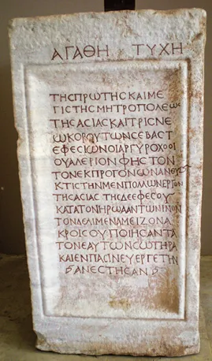
It is most unlikely that ancient silver work would be found today because silver, being a precious metal, was likely to have been melted down by looters over the centuries.
However, evidence that silver work was a flourishing trade during Paul’s time comes in the form of a monument erected by the silversmiths of Ephesus, which was discovered in 1984 near the city’s ancient theater. It was dedicated to the Roman proconsul Valerius Festus in the late 2nd or early 3rd century AD. The inscription on this marble block calls the proconsul their “savior and benefactor” and identifies the guild as silversmiths (argyrochooi) of the city.
The Temple of Artemis
Scripture mentions the temple of the great goddess Artemis. Archaeology has played its part here also.
Archaeological excavations in Ephesus began in 1863 by J.T. Wood, whose goal was to find the temple of Artemis. He worked for six years without success, until one day, while excavating the Great Theater, he unearthed an inscription that described how the idol of the goddess Artemis was carried to the theater once a year and how the procession entered the city by the Magnesian Gate and left by the Coressian Gate. When he located these gates, he was able to uncover the street which led him to the temple he had long searched for. Wood documented this discovery in his journal which is now online.[6]
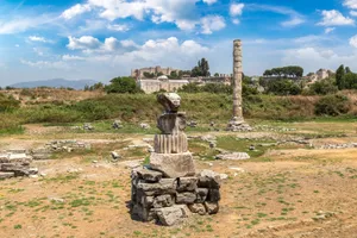
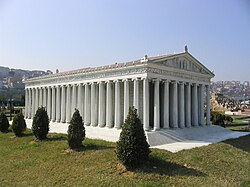 The Temple of Artemis was large and ornate; 115 meters long and 46 meters wide with 127 huge carved and decorated columns supporting the magnificent structure. It is one of the Seven Wonders of the Ancient World. Ony one of its columns remain as shown in the picture below. The image next to it is a model of the Temple of Artemis, at Miniatürk Park, Istanbul, Turkey, Images are credited to Encyclopedia Britanica. The colossal temple to the goddess Artemis and other great structures shows that Ephesus was a city of great wealth.
Statues of Artemis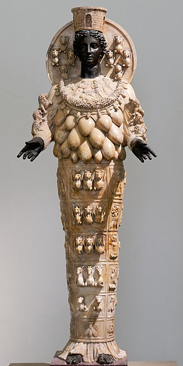
Many statues of Artemis have been found, and it is probable that the silversmiths fabricated smaller versions for people to take home, but more likely models of the temple. The one shown here is a statue made of Oriental alabaster with bronze extremities. The goddess wears a tower on her head and an aureole decorated with eight griffins. Round her neck a handsome collar of cereals fringed with acorns, and above it a design of female figures in bas-relief. Three lions are upon each arm, and between the arms the numerous breasts (although this is still debated) symbolical of her nourishing the world. Her skirt is covered with mythical and other animals. It is part of the Farnese Collection in the National Archaeological Museum, Naples.
Acts 19:29. Soon the whole city was in an uproar. The people seized Gaius and Aristarchus, Paul’s traveling companions from Macedonia, and all of them rushed into the theater together.
The Great Theater
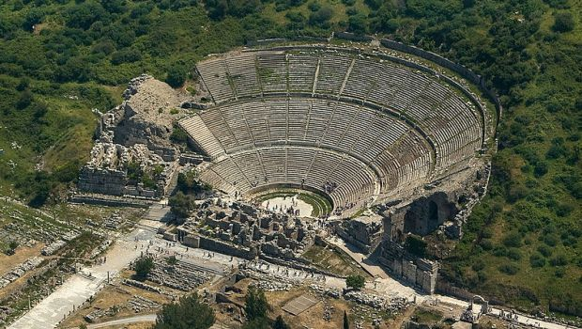
This was built in typical Greek style into the western side of Mount Pion, overlooking the harbour of Ephesus. It provided seating for 21,500 patrons.[7] It is one of the numerous historical sites where actual biblical events took place. Now, seeing the size of the theater, it is possible to comprehend the magnitude of the riot and understand why Paul’s friends would not let him go in to speak to the angry people (Acts 19:30).
City officials
Acts 19:31. And even some of the Asiarchs, who were friends of his, sent to him and were urging him not to venture into the theater.
Critics used to see Luke’s use of this term Asiarch as anachronistic. Such a title is not mentioned anywhere else in the Bible. The only other use of the term previously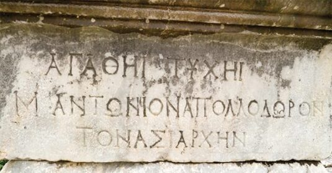 known was from classical sources, such as Strabo. Luke gives the title; Asiarch to officials who suggested to Paul that he not go into the arena during the Ephesus riot as recorded in Acts 19:31 It was not common in ancient literature, so scholars formerly viewed Luke’s use of the word with skepticism. However, the title has since been found on more than a dozen inscriptions.
The inscription right containing the title, uses the word. It was discovered in Miletus, which is only a short distance from ancient Ephesus,
Conclusion
Whenever there is a statement in the Bible that can be tested, it has been. Many of its people, places and events have been confirmed by archaeology. For example, the city of Ur from where God called Abraham[8] and the very large cities of Nineveh[9] and Babylon,[10] which were not recorded in any other document, were unearthed in the nineteenth century. Both the water spout that David’s men used to enter Jerusalem and capture it[11] and the 533 metre long tunnel constructed by King Hezekiah[12] to bring water into Jerusalem in the event of a siege, can be seen today. An ostracon (pottery) unearthed by G J Reisner in 1910 contained an inscription written in ancient Hebrew identified the clan and district name of seven of the offspring of Joseph’s son Manasseh (Jacob’s grandson). The Merneptah Stele, the Taylor Prism, the Nabonidus Chronicle, a Babylonian Chronicle, the Cyrus Cylinder, the Cyrus Inscription, the Pilate Inscription and the High Priest Caiaphas’ Ossuary all confirm the Bible is a historical record. In the field of cosmology, cosmologists have confirmed that the universe is expanding. The fact that God stretches (makes ongoing or makes continuous) the heavens is mentioned in the Bible nine times.[13]
The Bible states that when God had finished His act of creation, no more creation took place. This fact is corroborated by the First Law of Thermodynamics which simply put, says that matter cannot be created or destroyed. Einstein’s famous equation E=mc2 means that matter and energy are interchangeable, but the total must remain constant. The Second Law maintains that for a closed system, like the universe, order must go to disorder, and this is what is observed and stated in the Bible.[14]
Isaiah[15] tells us that the earth is round and Job[16] says it is hanging on nothing. Luke[17] infers that it is rotating with day and night being present at the same time. For this to happen, the earth would have to be rotating. Ocean currents were discovered by Matthew Maury after he read psalm 8:8 and the hydrologic cycle (water evaporating from the oceans and falling as rain) is described in five books of the Bible.[18] Genesis chapter 2 tells of how God made Eve from one of Adam’s rib bones. The rib bone is the only bone in the human body that will re-grow if it has been removed. Newly born babies can suffer from uncontrollable bleeding in the first seven days of life because they have low levels of a blood clotting factor; vitamin K. God told Abraham to circumcise all baby boys on the eighth day after birth.[19]
As shown, Paul’s encounter at Ephesus is no exception. The Bible is intellectually credible and historically defensible.
[1] Bryan Windle, Bible Archaeological Report, Evidence from Ephesus for the Reliability of Scripture, , November 6, 2017, page 9.
[2] The Jerusalem Post, April 19, 2022.
[3] Windle, page 4.
[4] https://en.wikipedia.org/wiki/Greek_Magical_Papyri; Hans Dieter Betz (Editor), The Greek Magical Papyri in Translation, Including the Demotic Spells, Volume 1: Texts Volume 1 Paperback – 1 January 1997.
[5] Artemis is her Greek name, While Dianna is her Roman name.
[6] DISCOVERIES AT EPHESUS INCLUDING THE SITE AND REMAINS OF THE GREAT TEMPLE OF DIANA, J T Wood, LONDON LONGMANS, GREEN, AND CO, 1877. https://www.academia.edu/44757393/J_T_Woods_1877_account_of_Ephesus_Discoveries_at_Ephesus_including_the_site_and_remains_of_the_great_temple_of_Diana.
[7] Archaeology Study Bible, Crossway, Wheaton, Illinois, 2017, page 1644.
[8] Genesis 11:31.
[9] The book of Jonah.
[10] Jeremiah 51:37 plus many others.
[11] 2 Samuel 5:6-9, 1 Chronicles 11:6 (in 1010 BC).
[12] 2 Kings 20:20, 2 Chronicles 32:3-4 (in about 700 BC).
[13] Job 9:8; Psalm 104:2; Isaiah 40:22, 42:5, 44:24, 45:12, 48:13, 51:13; Jeremiah 10:12, 51:15; Zechariah 12:1.
[14] Hebrews 1:10-11; Romans 8:20-22.
[15] Isaiah 40:22.
[16] Job 26:7.
[17] Luke 17:34-36.
[18] Amos 9:6; Isaiah 55:10; Psalm 135:7; Job 36: 27-28; Ecclesiastics 1:7.
[19] Genesis 17:12.

