Dear reader the aim of this blog article is not to teach the workings of DNA but rather to introduce you to the incomprehensible complexity of how DNA contains the instructions to build the species and how it goes about this task whether it be in a microbe, a magnolia, a mouse, or a man. After watching the short videos, you will understand the sheer desperation of evolutionists who say there is no need to believe the Bible because such complexity came about by the random and directionless joining of molecules to form not only DNA but also the other chemicals that bring about all the processes and biological pathways that are required for life. Romans 1:22; Although they claimed to be wise, they became fools.
Introduction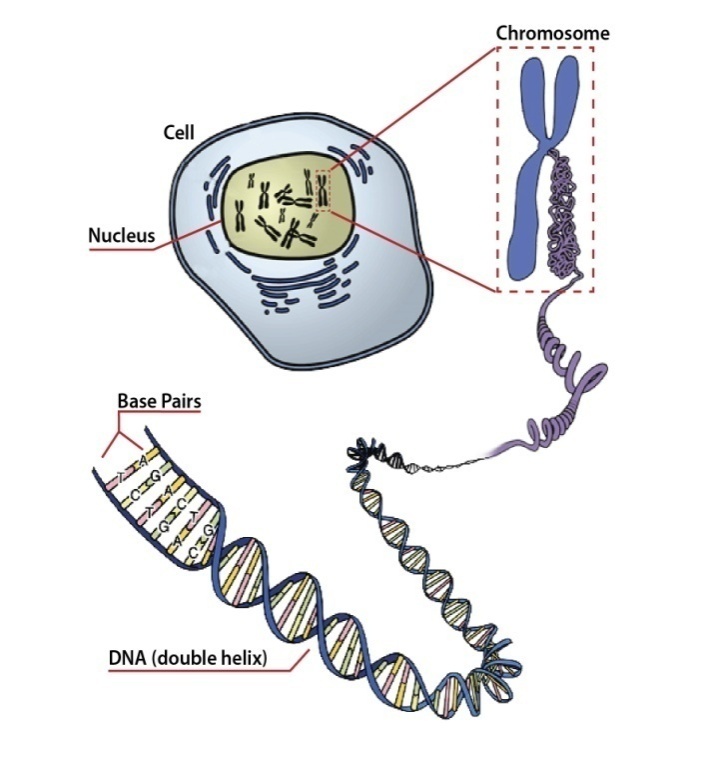
All known cellular life on Earth, including animals, plants, fungi, protists, bacteria, and archaea, possess DNA.
DNA (deoxyribonucleic acid) is the master blueprint for all life. Its primary function is to store, replicate, and transmit the genetic information required for an organism to develop, survive, and reproduce. It does this by using its biological code that contains all the structural instructions for living organisms. Packed within nearly every microscopic cell nucleus, this master blueprint dictates physical traits, biological functions, and even future health risks
What is DNA?
The two minute YouTube clip below answers this question. Click onto it then click on to “Watch on You Tube.”
What does DNA do?
The National Human Genome Research Institute[1] has provided the following information through its Fact Sheets.
Human DNA acts as the master instruction manual for our body. Organized into about 20,000 genes, its primary job is to tell our cells how to build proteins. These proteins then go on to form everything in our body, from our organs and tissues to our hair and eye color. It makes proteins in a two-step process called gene expression: transcription and translation. Because DNA is locked safely in the cell nucleus, it relies on an RNA messenger to carry its instructions to the cell’s protein factories.
The complexity of this information storage system is beyond our comprehension. Consider this; the same section of DNA can be read to form a protein. If it is read in reverse, a different protein will be formed. If the reading starts from a different position in the same section, a different protein is formed. If on the same section of DNA some of the genes are turned off, other proteins are formed. In this way, with genes turning on and off, many more proteins are formed.[2] These different reading processes can produce an incomprehensible 10 trillion proteins in each human cell.[3] Not only is DNA the greatest information storage system in the world, its information is stored in three dimensions and is packaged into the cell nucleus extremely tightly.
Here is a schematic video showing how DNA builds proteins
How does DNA replicate itself?
This is what Dr Lawrence Brody, Director Division of Genomics and Society had to say:
DNA replication is probably one of the most amazing tricks that DNA does. If you think about it, each cell contains all of the DNA you need to make the other cells. And we start out from a single cell and we end up with trillions of cells. And during that process of cell division, all of the information in a cell has to be copied, and it has to be copied perfectly. And so DNA is a molecule that can be replicated to make almost perfect copies of itself. Which is all the more amazing considering that there are almost three billion base pairs of DNA to be copied. And replication uses DNA polymerases which are molecules specifically dedicated to just copying DNA. Replicating all of the DNA in a single human cell takes several hours of just pure copying time. At the end of this process, once the DNA is all replicated, the cell actually has twice the amount of DNA that it needs, and the cell can then divide and parcel this DNA into the daughter cell, so that the daughter cell and the parental cell in many case are absolutely genetically identical.
Genes (segments of DNA) carry biological information that must be copied perfectly for transmission to the next generation each time a cell divides to form two daughter cells. Human DNA is contained in 23 units called chromasomes. The total number of nucleotides (links) is just about 3 billion and, as stated, theses must be copied exactly. If they are not, mutations occur. Most mutation are insignificant but some give rise to serious disorders like hemeachromatosis, cycle cell anemia, down sydrome, cycstic fibrosis, all cancers are the result of mutations, in fact there are now between 6,000 and 10,000 genetic disorders. Roughly, about 100 to 200 new mutations are accumulating with each generation.
The short video below shows how DNA replicates itself.
Below are some mind-bending facts regarding human DNA.
- If DNA is completely unravelled and the DNA strands from every single cell in our body are connected, the chain would stretch over 100 billion kilometres. This is long enough to reach from Earth to the Sun and back roughly 600 times. What enables this fact to be true is that DNA strands are extremely fine and they are folded and packed very tightly into the nucleous of each cell and there are about 37 trillion cells in each human being.
- A single strand of human DNA when pulled straight out of one cell is nearly 2 metres long. Yet, it successfully folds down to fit inside a microscopic cell nucleus.
- The human genome contains roughly 3 billion base pairs. If it were to be typed out at a speed of 60 words per minute for 8 hours a day, our complete genetic code would take 50 years to finish.
- Every single human being shares 99.9% of their DNA sequence with every other person on the planet. The entire spectrum of human diversity from eye colour to heigh comes from a tiny 0.1% variance.
- Only about 1% to 3% of our entire genome, codes for proteins (known as active genes). The remaining majority was historically dismissed as “junk DNA,” but scientists now know it plays a vital role in regulating how our genes behave.
- DNA is the most compact storage device known to science. A mere four grams of DNA is mathematically capable of holding all 1.8 zettabytes of digital information generated across the entire globe.
- DNA carries biological information through its chemical structure, specifically the sequential arrangement of four nucleotide bases: Adenine (A), Cytosine (C), Guanine (G), and Thymine (T). This sequence acts as a biological “alphabet”. Grouped in three-letter combinations (called codons), these sequences spell out the exact instructions needed to build and operate every living thing.
Conclusion
Friends, if your mind has not been blown away and convinced that evolution is a lie by the incomprehensible intricacy of functioning DNA after following this blog to here, then it will surely be if you spend 11 minutes to watch the video below from Creation Ministries International.
The nature of DNA with its enormous complexity caused Anthony Flew who was known worldwide as one who took every chance to denigrate anyone who believed in God, and described himself as the world’s greatest atheist, became a believer in God. In fact, he wrote a book describing his conversion.[4]
References
[2] Dominic Stratam, Creation, 41(3), 2019, page39.
[3] Rachel Crowley, Biomedical Best Blog, National Institute of General Medical Sciences, January 15, 2025. https://nigms.nih.gov/biobeat/2025/01/proteins-by-the-numbers.
[4] A. Flew with R. A. Varghese, There is a God, How the world’s most notorious atheist changed his mind, Harper One, 2007.

