Introduction
The following two paragraphs are taken from Wikipedia[1] and they reveal the thinking of secular archaeologists.
The Exodus is the founding myth of the Israelites. The scholarly consensus is that the Exodus, as described in the Torah, is not historical, even though there may be a historical core behind the Biblical narrative.
While a few scholars continue to discuss the historicity, or at least plausibility, of the exodus story, the majority of archaeologists have abandoned it, in the phrase used by archaeologist William Dever, as “a fruitless pursuit”.[2]
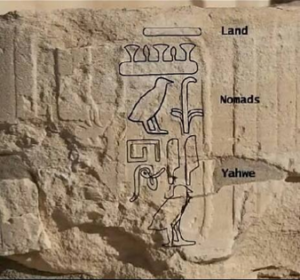
The Nomads of Yahweh Inscription
The following is an extract taken from an article written by Jude Flurry and published in the Armstrong Institute of Biblical Archeology.
On the west bank of the Nile in northern Sudan, stand the ruins of an ancient Egyptian town called Soleb. Europeans first learned of it when a Swiss traveller named John Lewis Burckhardt explored the region of Nubia in 1813. However, Soleb was not excavated until a century and a half later (from 1957 to 1963), by an archaeologist named Michela Schiff Giorgini. Giorgini’s excavation primarily focused on a temple complex dating to the reign of Pharaoh Amenhotep iii, who reigned sometime in the late 15th to early 14th centuries BC
This temple was undoubtedly built to honour the pharaoh. Its courtyard walls are inscribed with scenes of his “Heb-Sed” festival, an Egyptian celebration traditionally held in the thirtieth year of the monarch’s reign. Its many pillars bear images of the people he supposedly conquered (for example, one pillar pictures an African prisoner kneeling with his hands tied behind his back; other pictures a Semitic captive in the same position). In fact, the whole inner chamber was a symbolic representation of Amenhotep’s military conquests. Pictures of his subjugated northern enemies face northward, those of his southern enemies face southward, and so on.
However, the pillars of Soleb do at least accurately identify Egypt’s enemies. The Egyptians might have exaggerated their conquests, but they certainly didn’t decorate their temples with pictures of fictional adversaries. In this sense, the Soleb temple inscriptions provide accurate historical and geographical data.
As it turns out, one pillar at Soleb bears a cartouche (a term for an oval-shaped hieroglyphic inscription) of enormous biblical significance. It is badly damaged.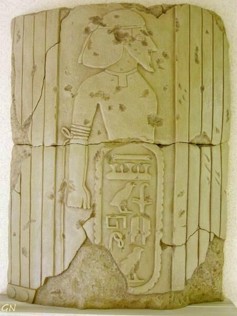 Originally, the cartouche would have been accompanied by an image of a kneeling slave, matching the other pillars. A reconstruction of how the whole column would have originally been shown below left. Photo Credit: https://flic.kr/p/dULpbp.
However, only the cartouche and the prisoner’s hands are still visible. Even the cartouche itself has been vandalized by locals within the past century. However, the inscription is still visible: It translates to “The land of the shasu of Yahweh.”[3]
Almost all scholars believe the Egyptian word “shasu” should be translated as “cattle-herding nomads,” or simply “nomads.” More significant, though, is the other name in the inscription. “Yahweh” undoubtedly refers to the God of the Hebrews, mentioned over 6,800 times throughout the Hebrew Bible. A few scholars have argued that
“Yahweh” could be a place name, since most of the other Egyptian enemies inscribed on Soleb’s pillars are identified by their dwelling places—for example, one pillar depicts the people of Megiddo. However, this theory is highly unlikely, as archaeologist Titus Kennedy notes: “[T]here is no topographical site in the entire region with the name Yahweh or anything similar.”
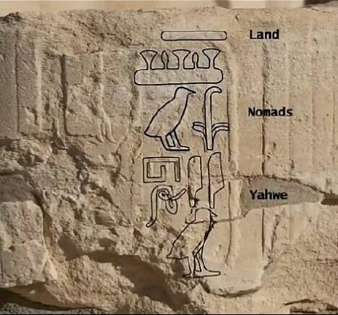 While the term Shasu is used primarily for semi-nomadic Semitic herders who lived north of Egypt, it also has a secondary usage in some New Kingdom texts for the geographic areas where the Shasu lived. When used geographically in Egyptian texts, the hieroglyphic word t3 is used, and this word should be translated as “land of.” In the case of these two references that we are discussing, the Egyptian phrase is t3 sh3sw ya-h-wa, i.e. “the land of the Shasu of Yahweh.”[4] Or, as explained above, the land of nomads of Yahweh
The Pharaoh of the Exodus
The Bible tells us in 1 Kings 6:1
In the four hundred and eightieth year after the Israelites came out of Egypt, in the fourth year of Solomon’s reign over Israel, in the month of Ziv, the second month, he began to build the temple of the LORD.
So, what year was the fourth year of king Solomon’s reign? Synchronisation between certain events in the reigns of later Israelite kings and Syrian chronological records fix the fourth year of Solomon’s reign at 966 BC. If Israel’s exodus is placed 480 years prior to 966, it would have occurred in 1446 BC.
There can be no doubt that the Pharaoh of the Exodus was Pharaoh Amenhotep II. Only he satisfied all the conditions which apply to this Pharaoh.
He reigned from 1453-1426 BC and satisfied the other two conditions for being the Pharaoh of the Exodus, namely his firstborn would have died in the final plague and it was his second born who inherited the throne. And his predecessor, Thutmose III had to have reigned for more than 40 years. In fact, he reigned 47 years. See https://www.adefenceofthebible.com/2023/06/14/who-was-the-pharaoh-of-the-exodus.
Amenhotep II was followed by Thutmose IV who reigned for ten years, 1426-1416. He was followed by Amenhotep III who reigned from 1416-1377 and this places him at the right time to refer to the Israelites as the Nomads of Yahweh, because when he came to the throne the Israelites had been wandering in the desert for ten years and still had 30 more years to go.
Note, the dates used are those proposed by Prof. Douglas Petrovich, for which he provides strong support.[5]
An archaeologist wanted to view this Bible-supporting inscription himself
Enjoy this six-minute video of archaeologist Joel P Kramer being so amazed at the reference of “nomads of Yahweh” inscribed on an ancient Egyptian column after reading the book, Egypt, Canaan, and Israel in Ancient Times, written by distinguish archaeologist Donald B Redford,[6] that he decided to travel to Soleb and check it out for himself. Click on the arrowhead and then onto You Tube.
Summary and Conclusion
The Israelites 400 years sojourn in Egyp,t where they went in as a family consisting of about 70 people and came out as a nation of about two million people; to be miraculously saved by the God they worshipped who was known to them as Yahweh, and then to take the land He had prepared for them. This happening formed the structure of the Old Testament.
The significance of this inscription in confirming the authenticity of the Bible cannot be overstated. It ties in nicely with the date given in the Bible for the Exodus, with Pharaoh Amenhotep II being the pharaoh of the exodus and Pharaoh Amenhotep III being in power during the Israelites wandering in the desert.
References
[1] https://en.wikipedia.org/wiki/Sources_and_parallels_of_the_Exodus.
[2] William Dever, What Did the Biblical Writers Know, and When Did They Know It?. Eerdmans. ISBN 9780802821263, 2001.
[3] Jude Flurry, Armstrong Institute of Biblical Archeology, October 10, 2022. https://armstronginstitute.org/768-the-soleb-inscription-earliest-discovered-use-of-the-name-yahweh.
[4] Clyde E. Billington, Associates for Biblical Research, The Name Yahweh in Egyptian Hieroglyphic Texts, March 8, 2010. https://biblearchaeology.org/the-name-yahweh-in-egyptian-hieroglyphic-texts.
[5] https://exegesisinternational.org/pdf/ExodusPharaohArticle.pdf.
[6] This book can be purchased today for many book sellers including Amazon.

