






As the persecution of Christians erupted in Jerusalem (Acts 8), culminating with the stoning of Stephen (Acts 7:54-60), Christians scattered. A few years after Paul’s Damascus Road experience he went back to his hometown of Tarsus. Barnabas, by this time a prominent Christian leader, was asked by the church leaders in Jerusalem to go to Antioch to investigate the good news they were hearing about the spiritual work taking place in the city. Barnabas first traveled to Tarsus to pick up Saul (Paul) and they both went to Antioch.
At Antioch, the Holy Spirit directs the church to set apart Barnabas and Saul (Paul) for work for which I have called them (Acts 13:2). They, (Barnabas’ cousin John Mark went with them also) travelled to Selecia from there, they sailed to Cypress. Acts 13:6-7:
They traveled through the whole island until they came to Paphos. There they met a Jewish sorcerer and false prophet named Bar-Jesus, who was an attendant of the proconsul, Sergius Paulus. The proconsul, an intelligent man, sent for Barnabas and Saul because he wanted to hear the word of God. But Elymas the sorcerer opposed them and tried to turn the proconsul from the faith. Then Saul who was also called Paul, filled with the Holy Spirit, looked straight at Elymas and said, “You are a child of the devil and an enemy of everything that is right! You are full of all kinds of deceit and trickery. Will you never stop perverting the right ways of the Lord? Now the hand of the Lord is against you. You are going to be blind, and for a time you will be unable to see the light of the sun.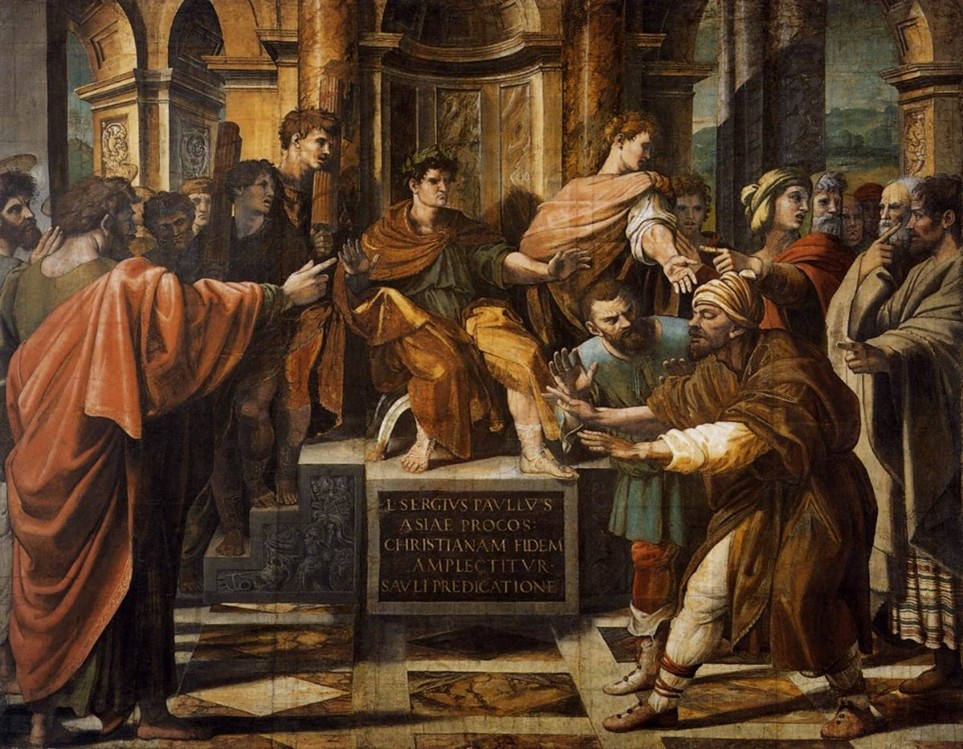
The painting above is by Raphael from the Raphael Cartoons and depicts Elymas the sorcerer, when he was struck blind before Sergius Paulus during Paul’s visit.
The verse in Acts, the book written by Luke, states that a Sergius Paulus was the proconsul and he lived in Paphos. In the Roman Empire, Provinces were divided under two different categories, those needing Roman troops and those that did not. The former was directly under the emperor, and the latter governed by the senate and ruled by proconsuls.
Cyprus, when Paul visited, had been under the administration of a proconsul from 22 BC until the time of Emperor Hadrian (117-138). The consensus of Bible scholars is that Paul visited Cyprus in AD 45 or 46. And as stated above Cyrus was under the administration of a proconsul. This is confirmed by Strabo, a 1st century BC and 1st century AD geographer and historian that Cyprus was a senatorial province during the Roman Empire in the 1st century AD.[1] The Encyclopedia Brittania tells us the city of Pathos became the administrative centre and the residence of the proconsul.[2]
So, from the above, Rome had the province of Cyprus governed by a proconsul who lived in the administrative capital of Paphos during the time of Barnabas and Saul (Paul)’s visit confirming what Luke wrote.
Luke tells us that the proconsul was Sergius Paulus. There are references to him from outside the Bible which support Luke’s assignment.
 dates to around AD 54. What we have is a squeeze of the original Soloi Inscription and it reads:
Apollonius to his father….consecrated this enclosure and monument according to his family’s wishes…having the offices of clerk of the market, prefect, town clerk, high priest, and having been in charge as manager of records office. Erected on the 25th month Demarchexusius in the 13th year (of the reign of Claudius- AD 54). He also altered the senate by means of assessors during the time of the proconsul Paulus.
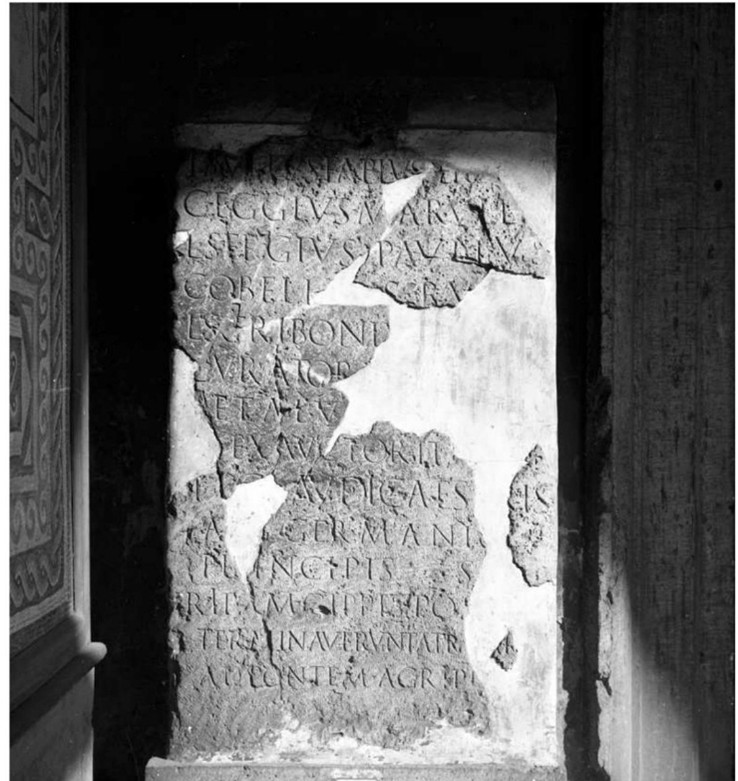 and names him as one of the curators of the Tiber river under Emperor Claudius Thus, a man named Lucius Sergius Paulus held a position as a Roman official overseeing the Tiber River in the middle of the first century. As commissioner of the banks and beds of the Tiber, he would have been responsible for managing the flow of the river to prevent the disastrous flooding that sometimes occurred in the city.
New Testament scholar, Ben Witherington III, concludes:
The fact that the Latin inscription, datable to the 40’s, like the text of Acts 13, mentions a prominent Sergius Paulus as a public figure suggests a connection between the two since clearly Paul’s visit to Cyprus must also be dated to the reign of Claudius in the later 40’s. This would provide one more piece of evidence, though indirect, that Luke is dealing with historical data and situations, not just creating a narrative with historical verisimilitude.
It is quite possible that Lucius Sergius Paulus served as commissioner of the Tiber River either before or after becoming the proconsul of Cyprus. While some have suggested that Sergius Paulus was demoted from his role as procurator of Cyprus after he put his faith in Christ, the dating of the inscription is not precise enough to pinpoint the order in which he served in each role.[3]
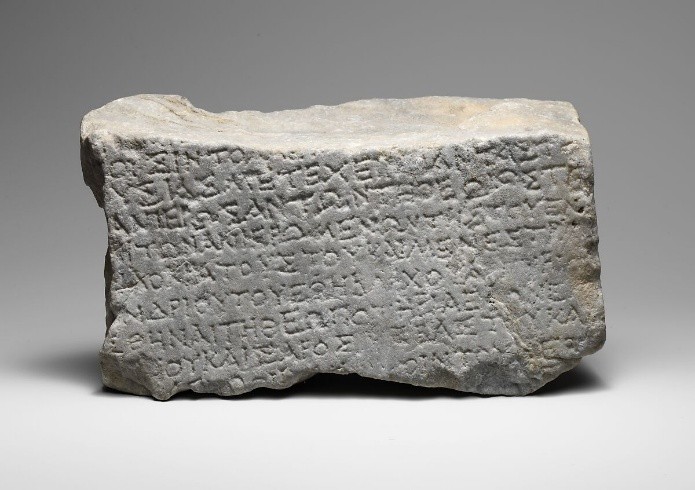 which makes reference to a “Quintus Sergius” whose last name is missing from the inscription but could possibly be Paulus. The inscription, found on a blue marble slab indicates that this man must have lived during the reign of either Claudius, Gaius, or Tiberius Caesar. One translation of the inscription which is located in the Metropolitan Museum reads:
“[CLAUD]IUS CAESAR SABASTOA ….[Q]UINTUS SER[GIUS PAULUS]”
As shown, the fragment also contains the name, Quintus Ser[gius]. If it refers to the Sergius clan, then it may be more evidence of the Sergius Paulus family lived on Cyprus in the early-to-mid first century. Photo: The Metropolitan Museum of Art / Public Domain
There existed different groups of magicians from the time of Moses such as Jannes and Lotape, of whom the Jews had spoken of. And in fact, many thousands each year, followed Zoroastrian ways especially during recent times on the Island of Cyprus.[4]
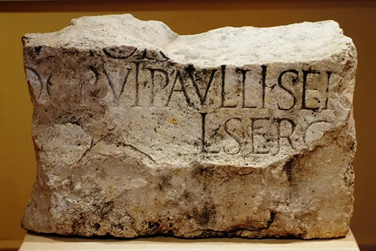 An inscription is on display in the Yalvac Museum within Turkey that was found in the vicinity of Pisidian Antioch which was a major military and administrative base for the Romans. The whole word “Paulii” and portions of “Sergii” are visible on it. The inscription itself may even be a reference to the Proconsul of Cyprus.
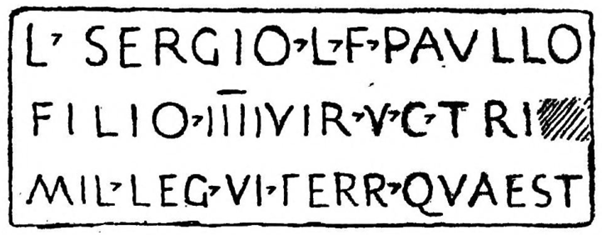 There are at least two inscriptions referring to the Sergius Paulus family around Pisidian Antioch and in 1913 Ramsay discovered the woman’s name Sergia Paulla on an inscription in the same region, which. have led some scholars to suggest that the family estate was nearby. These discoveries played an important part in his theory that the family of Sergius Paulus was Christian[5] and this raises an interesting possibility given that the apostles Paul and Barnabas made their way to this city immediately after they left Cyprus (Acts 13:13-14). Dr. Titus Kennedy summarizes:
It is possible, though unconfirmed and only a hypothesis based on circumstantial evidence, that the reason Paul and Barnabus travelled to Antioch after Cyprus is because Sergius Paulus had family ties there. If so, the L. Sergius Paulus mentioned on the stone inscription from Antioch may further illuminate the life of the proconsul Sergius Paulus who held positions on Cyprus and in Rome.[6]
While the dates which Sergius Paulus held the position of proconsul on Cyprus are not exactly known, two of the inscriptions demonstrate that his career as a Roman official encompassed the middle of the 1st century AD, and specifically during the reign of Claudius (ca. 41-54 AD). Following the chronology of the book of Acts, Paul and Barnabus should have arrived on Cyprus around 45 AD or slightly after. If Sergius Paulus was appointed a Curator in Rome in AD 47, then he may have moved to Rome upon his return from Cyprus, which was typically considered a province that Romans did not want to live in.
In his 1963 book, Roman Society and Roman Law in the New Testament, A.N. Sherwin-White argued that the book of Acts is historically reliable, stating that its historicity is overwhelming and that rejecting it, even in minor details, is “absurd”. He based this conclusion on his expertise in Roman public law and administration, finding that the book accurately reflects the details of Roman and Hellenistic life, such as legal procedures and the rights of Roman citizens.[7]
Whenever Luke’s naming of people and the position they held is investigated, Luke is found to be accurate. Whether it is Luke refering to Lysanias tetrarch of Abilene as a ruler in about AD 30, or Luke giving the title; Asiarch to officials who suggested to Paul that he not go into the arena during the Ephesus riot, or Luke mentioning the city council of Thessalonica as politarchs (Acts 17:6 & 8). All have been found to have been true. I have written about these names and positions here: https://www.adefenceofthebible.com/2016/10/14/luke.
[1] Discover Cyprus History and Flora of Cyprus, https://cyprustravels.org/history/roman-rule.
[2] Encyclopedia Brittania, https://www.britannica.com/place/Cyprus/External-political-influences.
[3] Bryan Windle, The Roman Tiber River inscription and the Cypriot Proconsul Sergius Paulus, Near East Archaeological Society Bulletin, 2022. https://www.academia.edu/111503175/The_Roman_Tiber_River_Inscription_and_the_Cypriote_Proconsul_Sergius_Paulus.
[4] https://www.biblehistory.net/newsletter/paulus.htm.
[5] William Ramsay, The Bearing of Recent Discovery on the Trustworthiness of the New Testament, Hodder and Stoughton, 1915, pages 150-172, cited in Joseph M Holden Norman Geisler, The Popular Handbook of Archaeology and the Bible, Harvest House Publishers, 2013, page 352.
[6] Windle above.
[7] A. N. Sherwin-White, Roman Society and Roman Law in the New Testament (Oxford: Clarendon Press, 1963), pp. 188-91; https://acjonquiere.com/_media/adrian-nicholas-sherwin-white-roman-society-and-roman-law-in-the-new-testament.pdf.



1 Comment. Leave new
Thanks again Gary, great job