




The pages of archaeological journals and books are awash with artifacts that confirm the truth and reliability of the Bible. Some of them are shown below.
In the Black Obelisk, we have confirmation of the biblical characters, Jehu king of Israel, Omni, and the powerful Assyrian king Shalmaneser III all in the correct place and time as they are mentioned in the Bible.
Apparently, David new about the water shaft, so he said to his men that the only way to conquer the Jebusites will be via the water shaft. In 1887, the British engineer, Captain Charles Warren discovered the shaft that now bears his name
Judean king, Hezekiah commissioned the construction of a tunnel to carry water from the Gehon Spring which was outside the city wall to inside the city to the Pool of Siloam and blocked off external access to it. The tunnel was discovered by Edward Robinson, an American Bible scholar now known as, Hezekiah’s Tunnel, in 1838.
These seals are just more pieces of evidence that are added to the ever-growing mountain that supports the existence of many people mentioned in the Bible.
The existence of the House of David was doubted by many Bible skeptics until 1993 when Avraham Biran and his team of archaeologists found an inscription on a piece of rock while excavating at Tell Dan. The stone was easily removed and when turned toward the sun, the letters were clearly visible. In their words, “It was an unforgettable moment.”
To dismiss John as historically unimportant is absurd. Now it becomes clear that the gospel of John does have reliable historical information. We have found there is such a pool, precisely as John describes it.
The above is only six of the Forty Three Bible-confirming discoveries I have written about in my website; adefenceofthebible.com. They can be found under “View all articles in our blog” and then under “Archaeology.”
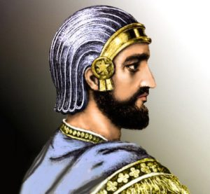
The prophet Isaiah foretold the coming of Cyrus of Persia, who is also referred to as Cyrus II or Cyrus the Great (c.600 – 530 BC). A very common image used to depict him is shown. He is mentioned 23 times in the Bible, some say he would allow God’s people to return to Jerusalem from exile in Babylon to rebuild the city and the temple. Isaiah’s prophecy was made in about 700 BC. This was at least 100 years before Cyrus was even born.
Isaiah 44:28 who says of Cyrus, ‘He is my shepherd and will accomplish all that I please; he will say of Jerusalem, “Let it be rebuilt,” and of the temple, “Let its foundations be laid.”’
Isaiah 45:1-6
1 “Thus says the Lord to His anointed, To Cyrus, whose right hand I have held– To subdue nations before him And loose the armor of kings, To open before him the double doors, So that the gates will not be shut:
2 ‘I will go before you And make the crooked places straight; I will break in pieces the gates of bronze And cut the bars of iron.
3 I will give you the treasures of darkness And hidden riches of secret places, That you may know that I, the Lord, Who call you by your name, Am the God of Israel.
4 For Jacob My servant’s sake, And Israel My elect, I have even called you by your name; I have named you, though you have not known Me.
5 I am the Lord, and there is no other; There is no God besides Me. I will gird you, though you have not known Me,
6 That they may know from the rising of the sun to its setting That there is none besides Me. I am the Lord, and there is no other;
Cyrus the Great became king of Babylon in October 539 BC, after his Persian forces captured the city.
Isaiah prophesies that God will raise up a king of Persia whose name will be Cyrus to allow the exiles to go back to Jerusalem to rebuild their destroyed city and to rebuild their temple. Esra writes in conformation of Isaiah’s prophecy: that the king of Persia whose name is Cyrus, has allowed the people to go back to Jerusalem, rebuild the city and rebuild the temple (Ezra 1:1-4).
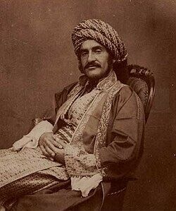 In a November 17, 1879, address at a meeting held by the Royal Asiatic Society, Sir Henry Rawlinson announced the discovery of the Cyrus Cylinder, which had been uncovered earlier that same year during excavations in Babylon, headed by Hormuzd Rassam (Pictured, courtesy Philip Delamotte) on behalf of the British Museum. Rawlinson’s paper on the cylinder, titled Notes on a Newly Discovered Clay Cylinder of Cyrus the Great, was published in January 1880 in the Journal of the Royal Asiatic Society.
The focus of the 1879 excavations was on the ruins of Esagila, a temple shrine dedicated to the god Marduk in Babylon (modern-day central Iraq). As the excavators dug around its walls, they uncovered a clay, barrel-shaped cylinder measuring approximately 23 centimeters (9 inches) long and 10.5 centimeters (4 inches) in diameter. The cylinder was covered in 45 lines of Akkadian cuneiform text.
Rassam acquired a permit from the Ottoman government signed by the sultan of Istanbul, allowing him to export his find back to England for examination. The British Museum took receipt of the cylinder in August 1879. Although the inscription was carefully reassembled by curator and Assyriologist Theophilus Pinches, significant chunks of the inscription were missing. Nearly a century later, in 1970, a large missing chunk of the cylinder was identified by Paul-Richard Berger among Yale University’s collection of inscription fragments. This fragment was delivered to the British Museum and added to the cylinder.[1]
Transcription of the whole 45 lines of the cylinder can be found here:
https://www.livius.org/sources/content/cyrus-cylinder/cyrus-cylinder-translation.
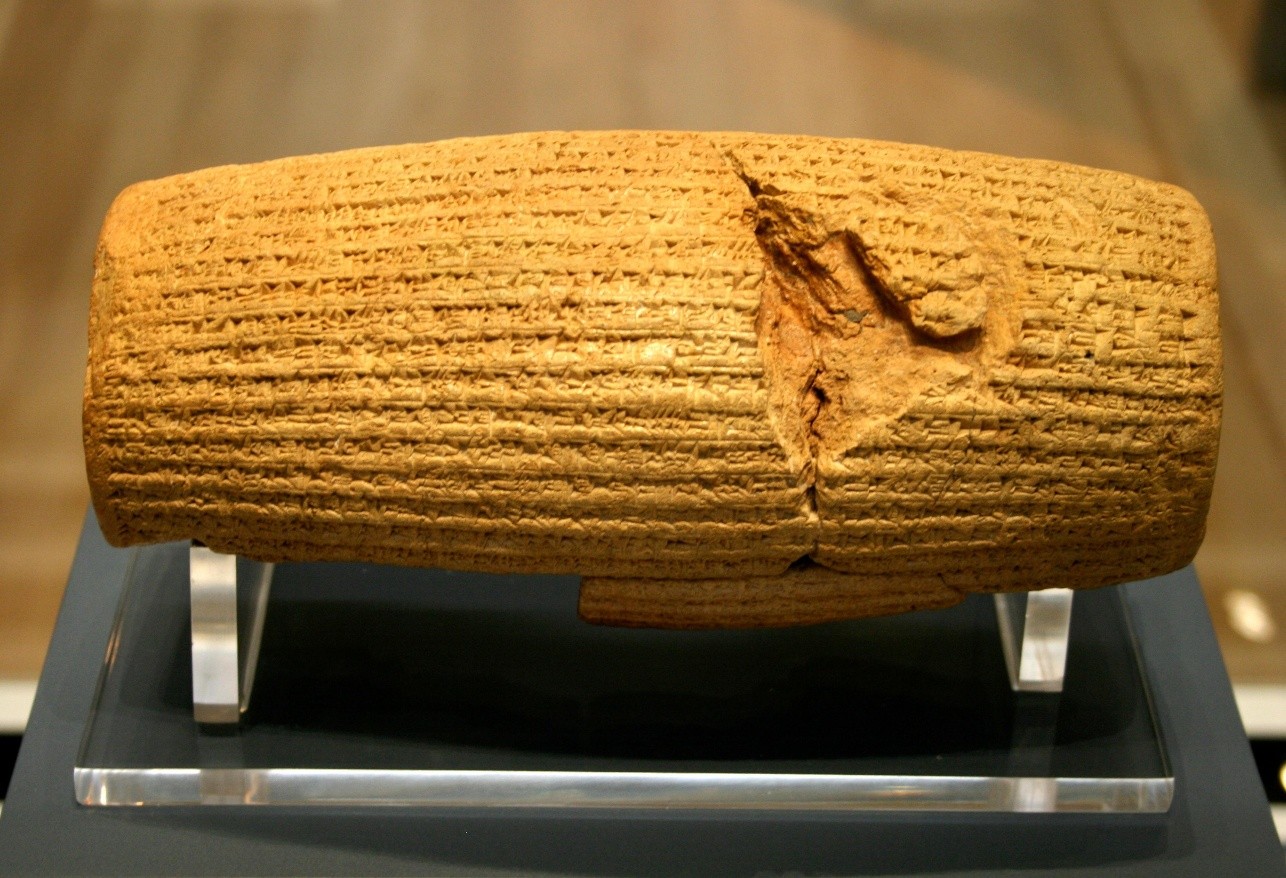
Line 12 of the cylinder states: seeking for the upright king of his choice. He took the hand of Cyrus, king of the city of Anshan, and called him by his name, proclaiming him aloud for the kingship over all of everything.
Isaiah wrote more than 100 years before Cyrus was born: Thus says the Lord to His anointed, To Cyrus, whose right hand I have held– To subdue nations before him And loose the armour of kings, To open before him the double doors, So that the gates will not be shut:
What the cylinder confirms are:
Line 15 and ordered that he should go to Babylon. He had him take the road
to Tintir (Babylon), and, like a friend and companion, he walked at
his side.
Line 16. His vast troops whose number, like the water in a river, could not be
counted, were marching fully-armed at his side.
Line 17. He had him enter without fighting or battle right into Shuanna; he
saved his city Babylon from hardship. He handed over to him
Nabonidus, the king who did not fear him.
Isaiah 45:1 Thus says the Lord to His anointed, To Cyrus, whose right hand I have held– To subdue nations before him And loose the armor of kings, To open before him the double doors, So that the gates will not be shut:
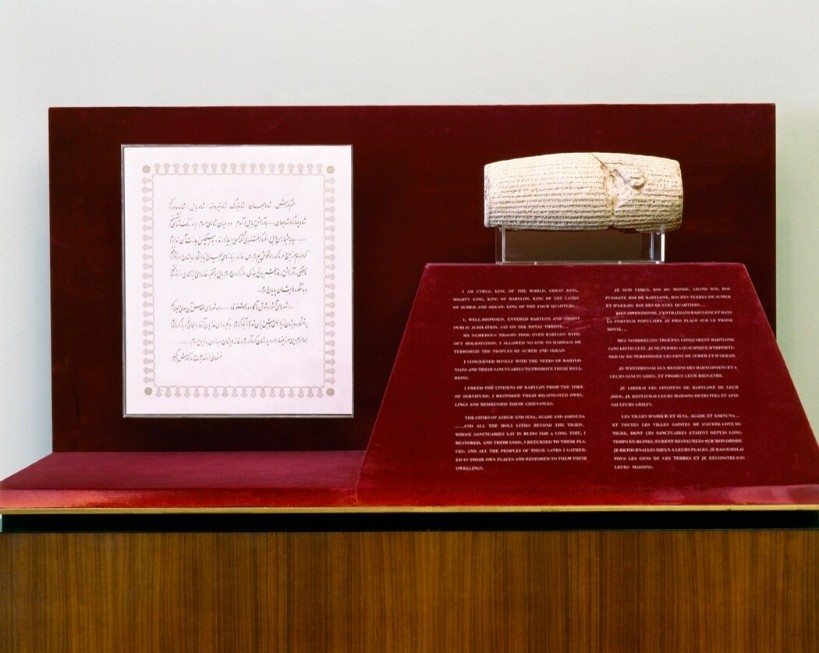
Ezra 1:1–3 (and 2 Chronicles 36:22–23) state what has become known as the Edict of Restoration, and it is known by the United Nations as the first statement of Human Rights, see image.[2] Also, it records the fulfillment of Isaiah’s prophecy.
In the first year of Cyrus king of Persia, in order to fulfill the word of the Lord spoken by Jeremiah, (an exile of 70 years, Jeremiah 20:11-12) the Lord moved the heart of Cyrus king of Persia to make a proclamation throughout his realm and also to put it in writing: ‘Thus says Cyrus king of Persia: “The Lord, the God of heaven, has given me all the kingdoms of the earth and he has appointed me to build a temple for him at Judah. Any of his people among you may go up to Jerusalem in Judah and build the temple of the Lord, the God of Israel, the God who is in Jerusalem.
Line 31. Akkad, the land of Eshnunna, the city of Zamban, the city of
Meturnu, Der, as far as the border of the land of Guti – the
sanctuaries across the river Tigris – whose shrines had earlier
become dilapidated,
Line 32. the gods who lived therein, and made permanent sanctuaries for
them. I collected together all of their people and returned them to
their settlements,
Line 33. and the gods of the land of Sumer and Akkad which Nabonidus – to
the fury of the lord of the gods – had brought into Shuanna, at the
command of Marduk, the great lord,
Line 34. I returned them unharmed to their cells, in the sanctuaries that make
them happy. May all the gods that I returned Cyrus allowed all captive to their sanctuaries,
become dilapidated. This is consistent with the Jews returning to Jerusalem (across the Tigres) to rebuild both the city and the temple.
The Cyrus Cylinder provides support for eight statements recorded in the Bible. Five statements were prophetic from Isaiah, so they not only provide evidence for the fidelity of the written word but confirm Isaiah’s prophecy as well. The United Nations based their Edict of Restoration which became the first statement of Humas Rights which is based on the release of captives by Cyrus written on the Cyrus Cylinder.
[1] Heather Lexa, The Cyrus Cylinder: an Almost Unbelievable Biblical Decree, Armstrong Institute of Biblical Studies, October 23, 2026.
[2] https://www.un.org/ungifts/replica-edict-cyrus.
I am text block. Click edit button to change this text. Lorem ipsum dolor sit amet, consectetur adipiscing elit. Ut elit tellus, luctus nec ullamcorper mattis, pulvinar dapibus leo.